
Why You Quit Decluttering After One Week and 3 Tools to Fix It (Ep 306)
About the episode
If you’ve ever started decluttering, felt amazing for about a week, and then completely lost steam, this episode explains why. It’s not a willpower problem. It’s not laziness. Your brain is playing a trick on you, and once you understand it, it loses its power.



Helpful Links:
Links mentioned in this episode (some may be affiliate links):
Comment HOME on my latest Instagram post (@wannabeclutterfree) and I’ll send you the link to Effortless Home.
If you’ve ever started decluttering your home, felt that incredible rush of progress for about a week, and then suddenly felt like nothing you did made a difference, I want you to know something: you are not alone, and there is nothing wrong with you.
There is a very specific thing happening in your brain around the end of that first week, and it has a name. I call it the motivation cliff. And in Episode 306 of the Wannabe Clutter Free podcast, I’m breaking down exactly what it is, why it happens to literally everyone, and the three tools I use to push past it.
Key Takeaways
The motivation cliff is real and happens to everyone around day 7 of decluttering
The recalibration dip is your brain absorbing progress and making it invisible, not a sign that you failed
Count items out the door instead of measuring by how your home looks
Joy is the fuel, not the reward. Make the process enjoyable or you won’t sustain it
Finish small spaces completely before starting new ones. Completion builds the identity of a finisher
Motivation follows action, not the other way around
What Is the Motivation Cliff?
When you start decluttering, you’re running on what I call the burst effect. Days one through three, your brain loves the novelty. Everything feels exciting. You’re seeing quick wins, clearing counters, filling up donation bags. There’s a dopamine hit every time you finish a drawer or a shelf.
Days four through six, that’s momentum. You’re in a groove. You’re proving to yourself that you can do this.
And then around day seven, your brain recalibrates.
Your brain’s primary job is to keep you safe, and generally safe means status quo. So once your decluttered space starts feeling “normal,” your brain absorbs the change. That room that felt so much better three days ago just looks like your room now. The progress becomes invisible, not because it didn’t happen, but because your brain adjusted to it.
I call this the recalibration dip. And it’s the single biggest reason people quit decluttering. Not the physical work. Not the sentimental stuff. This invisible brain trick that makes you feel like you’ve done nothing when you’ve actually done a lot.
Think about it like getting a new car. At first, you notice it everywhere. A month later, it’s just your car. Or a new haircut. Everyone compliments it for a few days, and then it’s just how you look. Your home does the same thing after a declutter. The excitement fades because your brain recalibrated to the new normal.
Tool 1: Count Items Out the Door, Not How Your Home Looks
We’re wired to measure decluttering by looking around the room. Does it look better? Does it feel different? But that visual metric is exactly what your brain will recalibrate on.
Instead, count how many items have left your home. That’s your scoreboard. Your brain cannot recalibrate around a number. If 47 items left your house, that’s 47 items. Period. You can’t wake up the next morning and feel like it didn’t happen when the number is staring right at you.
The average American home has over 300,000 items. 500 items is less than two tenths of a percent, and yet that’s about 20 grocery bags of stuff. You would absolutely feel that leaving your home.
I use a visual tracker for this. It’s part of the 500 Item Declutter Challenge inside my 19 for $19 bundle. You color in circles as you go, the numbers fill up, and when your brain tries to tell you nothing has changed, you pull out that tracker and let the proof speak for itself.
Tool 2: Find Joy During the Process, Not After It
Most people treat decluttering like something you suffer through so you can enjoy your home later. Suffer now, enjoy later. And I think the entire decluttering industry gets this backwards.
If the process feels miserable, you will never sustain it. This is why diets fail. You can’t just eliminate everything without addressing the underlying habits and mindset. Decluttering works the same way. If you’re just grinding through it, you’ll hit the motivation cliff at day seven with zero reason to keep going.
So flip it. Joy is the fuel, not the reward. Put on a playlist (I have a breakup songs playlist on Spotify that’s perfect for this, because you’re essentially breaking up with your stuff). Pour a cup of coffee. Light a candle. Invite a friend over. If you’re dealing with easy stuff like a junk drawer, put on an audiobook or a show. Make the work itself enjoyable.
The person who builds a clutter-free home for life isn’t more disciplined than you. They just figured out how to enjoy the process enough to keep showing up.
And you don’t have to wait for motivation to show up first. You show up. You build momentum. And then the motivation follows. You don’t wait to brush your teeth until you feel like it. You just do it. Decluttering can be that simple too.
Tool 3: Finish What You Start, Even If It’s Small
This is the one that changed the most for me personally. I am naturally a starter. I love the energy that comes with beginning something. But finishing has always been harder for me. If that’s you, I see you. It doesn’t mean you’re broken. It just means we need to build the finishing muscle.
The rule is simple: do not move to a new area until the one you’re in is 100% complete. And that area can be really small. One drawer. One shelf. Just the top of your desk. Finish it completely before you open the next drawer.
Because every time you fully complete a space, you are teaching your brain that you are the kind of person who finishes things. That identity shift, from starter to finisher, is worth more than any amount of motivation. Motivation comes and goes. But “I am a person who finishes what I start” stays.
I would rather you finish one drawer completely than start three rooms and leave them all half done. One finished drawer is proof. Three half-done rooms is just a bigger mess that feeds the motivation cliff all over again.
What’s Next
This episode is part of a series designed to take you from “I want to declutter” to actually living in a clutter-free home. If you haven’t listened yet, start with Episode 304 (the 15-minute declutter method) and Episode 305 (the Joy Anchor Method for sentimental items).
Next week I’m talking with Leidy Klotz, author of In a Good Place, about how the spaces where we live, work, and play help us thrive. And then the episode after that, I’m giving you the 10-minute daily routine that keeps clutter from coming back. That’s the piece that makes all of this permanent.
Don't forget to subscribe to the Wannabe Clutter Free podcast (on your favorite podcast player!) so you never miss an episode. And if you liked what you heard today, please leave a rating and review for the show too! It helps others find the show and makes my day.
BEFORE YOU GO!
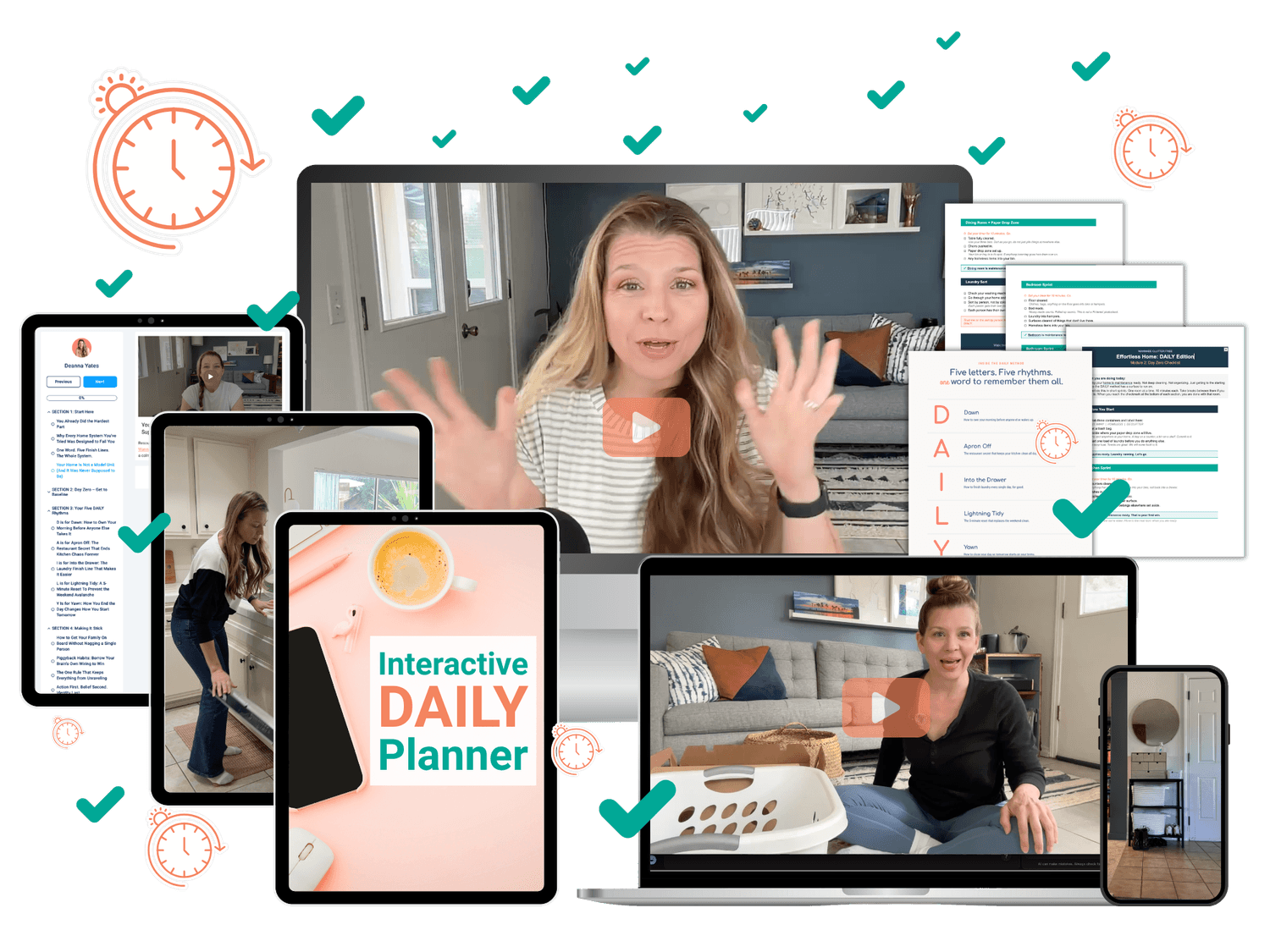
✨ Snag my DAILY routine that keeps my home tidy & calm in just minutes a day ✨
cheers!
About Deanna Yates
Based in San Diego, CA, Deanna helps high-achieving moms clear the clutter from their homes and lives.
Through coaching, courses, summits, and her top-ranked Wannabe Clutter Free podcast, she supports modern women in building organized, peaceful homes where they can thrive.


Some of the links on this site are affiliate links for your convenience (which means if you make a purchase after clicking a link I will earn a small commission but it won’t cost you a penny more)! Read my full disclosure policy.
Wannabe Clutter Free is a participant in the Amazon Services LLC Associates Program, an affiliate advertising program designed to provide a means for sites to earn advertising fees by advertising and linking to Amazon.com.
© 2026. All Rights Reserved