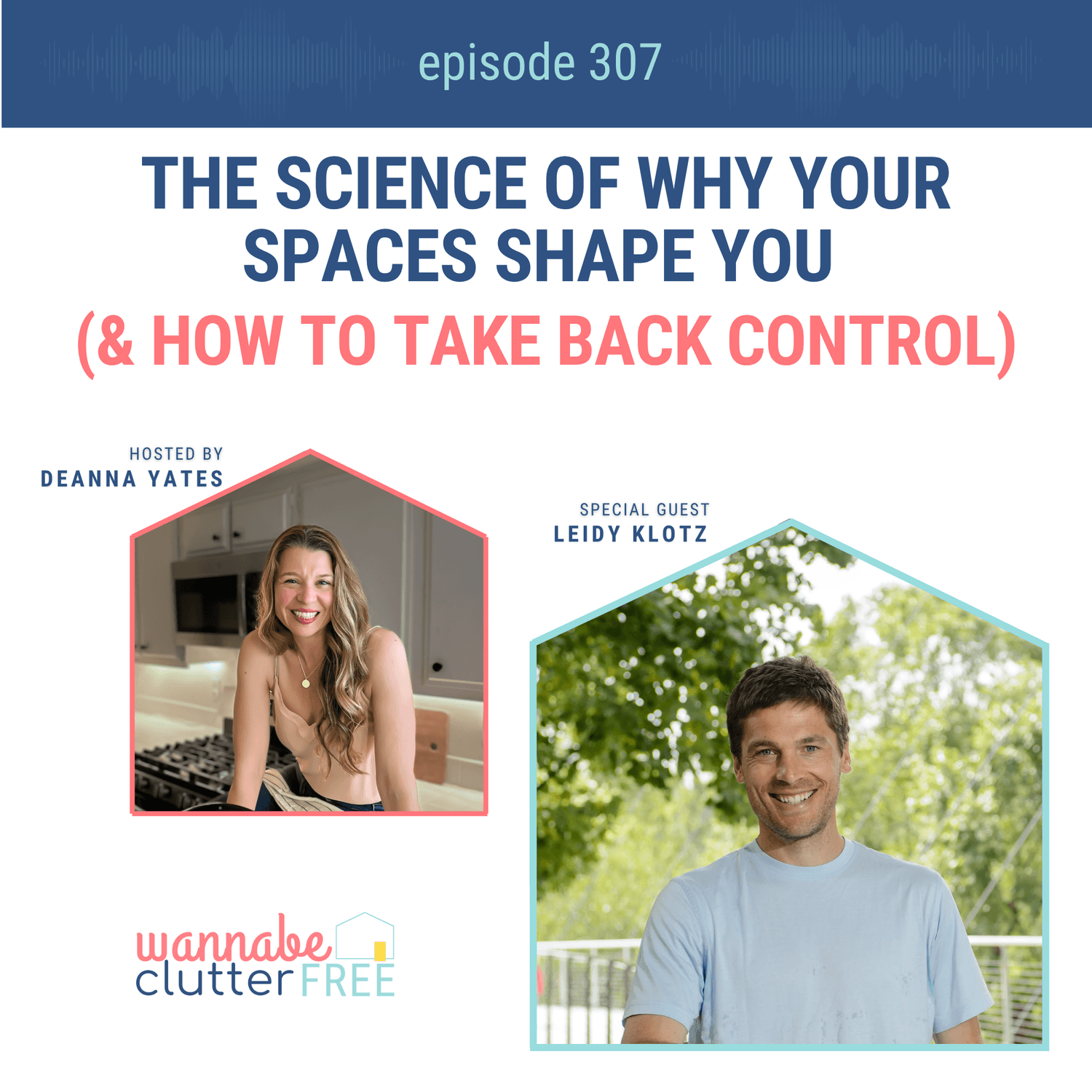
The Science of Why Your Spaces Shape You (And How to Take Back Control) with Leidy Klotz | Ep. 307
About the episode
Behavioral scientist Leidy Klotz reveals how your home feeds or starves three core psychological needs, why clutter blocks connection, and how to make your spaces actually work for your family.



Helpful Links:
Links mentioned in this episode (some may be affiliate links):
Connect with Leidy
We spend so much energy on mindset, habits, and routines. But what if the spaces where we live, work, and play are quietly shaping everything, and we are not even paying attention?
That is the question at the heart of today's conversation with Leidy Klotz. Leidy is a behavioral scientist and engineering professor at the University of Virginia. You might know him from his first book, Subtract, which explored our deep human bias toward adding instead of taking away. His brand-new book, In a Good Place, takes the next step: now that we know the power of less, where do we apply it? And how do our physical environments shape who we are?
This conversation hit so many nerves for me. As someone who has built an entire brand around decluttering, I have always known that our spaces matter. But hearing Leidy connect the dots between the clutter in our homes and our actual ability to connect with the people sitting right in front of us? That hit different.
Our Spaces Feed or Starve Our Core Needs
Leidy walks us through the three core psychological needs that our spaces either support or work against: agency, growth, and connection. These are not just abstract ideas. Agency is the feeling that you have a say in what is happening around you. Growth is the sense that your environment is challenging you and helping you learn. Connection is about being able to truly be present with other people.
Think about it through the lens of a kid building a sandcastle on the beach. They get to choose where to build and what design to make (agency). Every attempt teaches them something about how sand works (growth). And when they recruit their cousins to help and yell at Dad to haul water, that shared effort bonds everyone (connection).
Now think about your home. Does it give you a sense of control, or does it feel like it is running you? Does it challenge you in small positive ways, or have you been doing everything the exact same way for years? Does it set you up to really be present with your family, or are there a thousand visual distractions competing for your attention?
How Clutter Gets Between You and the People You Love
This was the part of the conversation that made me want to stand up and cheer, because it is the science behind everything I have been teaching. Leidy explains that we are wired to pay attention to our surroundings. Our brains scan for threats, opportunities, and information. When someone walks into your home and sees piles of mail, scattered shoes, stacks on the counter, their brain is processing all of it. And we only have the bandwidth for about one conversation's worth of information at a time.
So if your brain is busy scanning shin guards and mail piles, it is not fully available to connect with the person right in front of you. Clutter is not just messy. It is a literal barrier to connection. And that is one of the most powerful reasons to declutter that I have ever heard.
The Family That Moved Dinner Outside
One of my favorite stories from the episode is about a family with two sets of twins and two working parents. Dinner was a nightly disaster, tantrums bouncing off kitchen walls. Then they started eating every single meal outside on their patio, and everything changed. The spills did not matter (nutrients cycling back into the ecosystem, as the dad put it). The kids could run around after eating instead of being trapped at the table. Mom and Dad could actually enjoy their food.
That patio was always there. They just never thought to use it as a dining room. Leidy calls this functional fixedness, the idea that adults get so locked into what a space is 'for' that we stop seeing other possibilities. And here is the kicker: kids are actually better at this than we are. So maybe the next time your current routine is not working, ask your kids what they would do with the space instead.
Getting Your Kids Involved Changes Everything
Speaking of kids, Leidy makes a powerful case for involving them in decisions about your home. When his son got to choose the color of the stair pads, he was completely bought in. It was a simple carpet pad, but it was his choice, so it mattered.
For the moms listening, this is a game-changer for decluttering, too. Instead of asking your kids to go through their stuff (which never goes well), ask them to dream up a new way to use a room. They will love having the input, and then they will naturally start making decisions about what stays and what goes to make their vision work. You are not asking them to declutter. You are asking them to create, and the decluttering happens as a byproduct.
The Renovation Trap: Nostalgia vs. the Dopamine Hit
Leidy shares a thought that stopped me mid-scroll: we can remodel the kitchen until we are blue in the face without getting any closer to happiness, sacrificing nostalgia in the process. He explains that renovating and redecorating gives us a dopamine hit, the same reward loop that keeps us reaching for our phones. But nostalgia grows with time and connects us to the people and memories that matter most.
He tells this beautiful story about a family cottage in New Jersey that has been passed down for generations. The outdoor shower has been updated over the years, but there has always been an outdoor shower. That is the part that carries meaning. The tip is to think before you renovate: what elements of this space carry emotional significance? How do I protect those while still refreshing what needs refreshing?
When Leidy asks his college students to name their favorite place in the world, the answer is almost never some exotic destination. It is grandma's porch. The dock on the lake. The corner booth at their hometown diner. These are ordinary spaces made extraordinary by meaning, memory, and the people who were there.
Remembering Josie
Woven throughout this conversation is the story of Leidy's daughter Josie, who passed away unexpectedly on Christmas 2023 at four years old. Josie was already the hero of the book before she died: her sandcastles, her shortcuts through neighbors' yards, the time she pushed her high chair in front of the pantry and served herself.
One of Josie's lasting gifts is Josie's Way, trails and paths created in her honor. It started when she renamed a marble inscription on a campus path as 'Josie's Way,' and now her cousins, friends, and Leidy's former students have created their own Josie's Ways all over the country. It is a beautiful example of how spaces can carry spirit and meaning forward long after someone is gone.
Leidy's willingness to share Josie's story is a gift. If it does nothing else, I hope it makes you hug your kids a little tighter and pay attention to the spaces you share with them.
About Leidy Klotz:
Leidy Klotz is a behavioral scientist and engineering professor at the University of Virginia who studies how and why humans design.
He has written for the Washington Post, Fast Company, Scientific American, and Harvard Business Review; has published his work in top journals like Nature and Science; and has been interviewed on Hidden Brain, Freakonomics, Mindscape, and The Atlantic's How to Build a Happy Life.
His books include Subtract: The Untapped Science of Less and In a Good Place: Finding Surroundings Where We Can Grow, Connect, and Matter.
Time Stamps:
00:00 Introduction and Leidy's background
05:40 The intersection of environment and behavior
11:24 The three core psychological needs: agency, growth, and connection
17:25 Agency and connection in the home (plus tips for renters)
20:30 How clutter literally blocks connection
26:50 Behavioral changes through environmental cues
32:23 The family that moved dinner outside
36:06 Functional fixedness: why adults are worse at this than kids
40:42 Nostalgia, the renovation trap, and protecting what matters
50:57 Josie's Way: remembering through spaces and stories
55:30 Rapid fire: choosing space over screen
Music: Fresh Lift by Shane Ivers - https://www.silvermansound.com
Subscribe & Review:
We’d love to hear how you’re applying the strategies discussed in this episode. Share your stories and tips with us on social media (@wannabeclutterfree). Don’t forget to subscribe for more insightful episodes designed to make your busy life a bit easier.
BEFORE YOU GO!
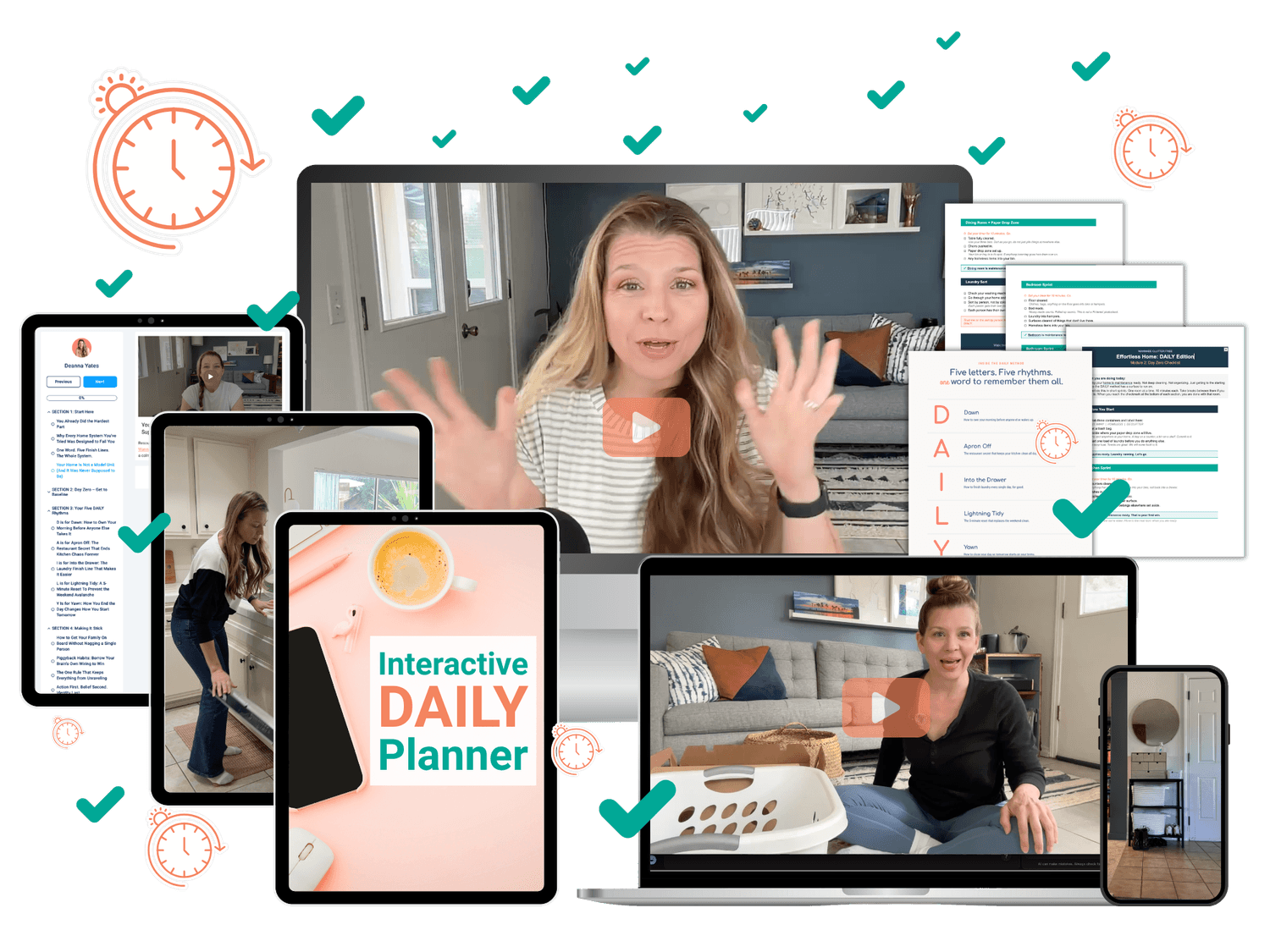
✨ Snag my DAILY routine that keeps my home tidy & calm in just minutes a day ✨
cheers!
About Deanna Yates
Based in San Diego, CA, Deanna helps high-achieving moms clear the clutter from their homes and lives.
Through coaching, courses, summits, and her top-ranked Wannabe Clutter Free podcast, she supports modern women in building organized, peaceful homes where they can thrive.


Some of the links on this site are affiliate links for your convenience (which means if you make a purchase after clicking a link I will earn a small commission but it won’t cost you a penny more)! Read my full disclosure policy.
Wannabe Clutter Free is a participant in the Amazon Services LLC Associates Program, an affiliate advertising program designed to provide a means for sites to earn advertising fees by advertising and linking to Amazon.com.
© 2026. All Rights Reserved