
How a 5 Minute Daily Tidy Beats One Big Weekend Declutter (Ep 318)
About the episode
If a big weekend declutter has failed you in the past, you are not alone. I’m breaking down the Zeigarnik effect, decision fatigue, and task initiation aversion, and teaching you the 5-minute Lightning Tidy that gets you a tidy home the easy way.
Powered by RedCircle



Helpful Links:
Links mentioned in this episode (some may be affiliate links):
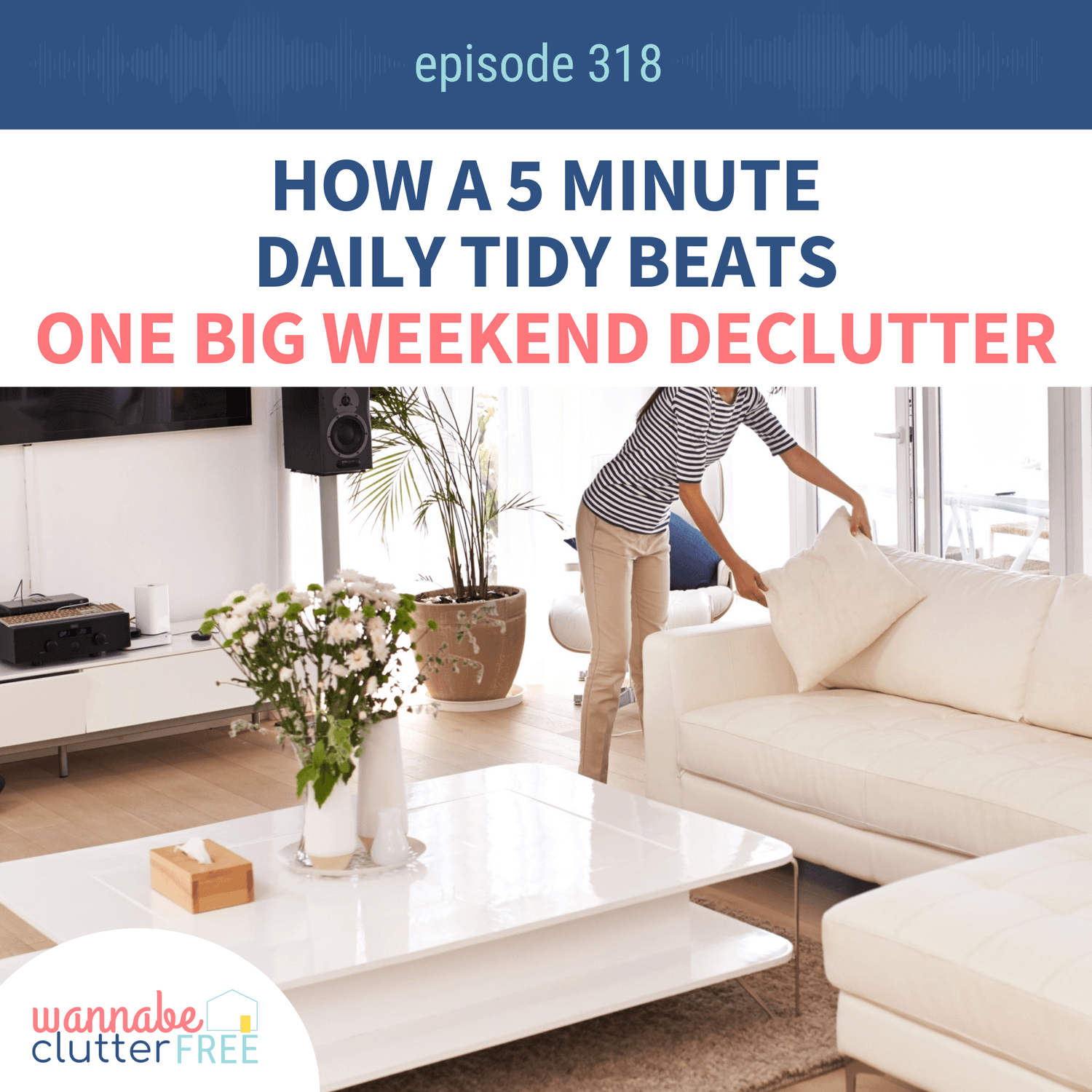
You know the moment. It’s a weeknight, probably after dinner. You look around your kitchen and everything has accumulated. Groceries that need to be put away, creative projects spilling off the table, dishes from two meals ago. And you are so fed up that you say it: I am going to do the entire house this weekend.
You mean it. You plan for it. You get through Thursday and Friday thinking about it. And then Saturday comes and either you don’t start because the task feels too big to know where to begin, or you start and make things worse, or you finish and feel great for four days before it looks exactly the same.
In episode 318 of Wannabe Clutter Free, I’m explaining why that cycle is not a discipline problem. It is a brain problem. And I’m introducing the approach that changes everything: the Lightning Tidy.
Why Your Brain Works Against the Big Session
There are three neurological mechanisms fighting against you every time you attempt a large decluttering session.
The first is the Zeigarnik effect. In 1927, psychologist Bluma Zeigarnik discovered that incomplete tasks are stored differently in memory than completed ones. Unfinished tasks stay in active working memory, continuously flagged as requiring attention. A 2011 study by Masicampo and Baumeister confirmed that unfinished goals don’t just sit in memory passively. They actively degrade performance on other cognitive tasks. Participants carrying unresolved goals performed measurably worse on reading comprehension. Their executive resources were still allocated to the open goal even when they were doing something entirely different.
Every pile of clutter in your home is an open loop. Your brain is maintaining a thread of tension around it whether you’re consciously thinking about it or not. And when you’re living with dozens of open loops simultaneously, you cannot fully rest, even when you’re sitting on the couch doing nothing.
The second mechanism is decision fatigue. Every object in a cluttered environment requires a micro-decision: what is this, where does it go, does it stay? Your brain has finite decision-making capacity in any given day. By the time you stand at the start of a big weekend session, you have been depleting that capacity all week simply by living in the space. The paralysis you feel looking at a cluttered room isn’t weakness. It’s your brain accurately reporting that its resources are already spent.
The third mechanism is task initiation aversion. The bigger a task feels, the harder it is to start. Your brain’s threat-assessment system runs a cost-benefit calculation and decides a four-hour session isn’t worth initiating. Five minutes passes the calculation easily.
The Lightning Tidy: What It Is and How It Works
A Lightning Tidy is five minutes, every day, at the same time, doing a similar reset routine. The goal is not to clean. It is not to declutter. The goal is to reset: returning things to where they belong so tomorrow starts at zero instead of digging out from yesterday.
In our home, the Lightning Tidy happens right after dinner. Music goes on, something upbeat, and we move through the main living spaces as a family. Shoes by the door, backpacks in their spot, blankets back on the couch, surfaces wiped, things back where they live. Five minutes. Timer goes off, we stop, even if everything isn’t perfect.
The family math here is worth noting. If three people do a five-minute Lightning Tidy together, that is 15 minutes of human tidying power happening in five minutes of clock time. Four people is 20. Five is 25. This is one of the most efficient habits a household can build.
The Lightning Tidy bypasses all three neurological failure points. It closes open loops each night, telling your brain the loops are handled. It eliminates decision fatigue because resetting is not deciding, it is a known action. And it clears the initiation barrier because five minutes is a commitment any brain will agree to start.
Why It Works Especially Well for ADHD Brains
Traditional decluttering advice relies on sustained attention, complex in-the-moment decision-making, and the ability to hold a visual end state in mind while you work. These are exactly the executive functions ADHD affects most directly.
There’s also what researchers call visible storage: a coping mechanism ADHD brains develop because out of sight is genuinely out of mind. Things stay visible so they won’t be forgotten. But visible things create visual clutter, which creates the cognitive load that makes everything harder. It’s not a character flaw. It’s a trap that standard tidying advice makes worse.
The Lightning Tidy works for ADHD brains because it’s short enough to initiate, structured enough to not require active decision-making, and anchored to the same time and trigger every day so it doesn’t rely on working memory. The routine carries the habit so the brain doesn’t have to.
How to Make It Stick: Peggybacking and Identity
Habit research shows that new behaviors form fastest when attached to something you already do automatically. I call this peggybacking, because the new habit rides on the back of an existing one. For our family, the trigger is putting plates in the sink after dinner. That action is the cue and the Lightning Tidy follows automatically. Your trigger will be different: the dishwasher starting, an evening show ending, kids heading to brush their teeth. Find the daily moment that already happens without you remembering it, and attach the Lightning Tidy there.
The other piece is identity. James Clear, in Atomic Habits, makes the point that the most durable form of behavior change is not wanting a tidy home but being the kind of person who resets their home every evening. Research on habit formation suggests it takes an average of 66 days for a new behavior to become automatic. Sixty-six Lightning Tidies is 66 times 5 minutes: five and a half hours total. That is a couple of movies. That is the trade available to you.
What Comes Next: The Mighty Tidy
Once a week, you go deeper. Thirty minutes, one specific area. That is the Mighty Tidy. You might do your whole kitchen one week, or if the kitchen feels too big, you start with one drawer and see how far you get. The Lightning Tidy keeps you from spending your 30 minutes just getting back to baseline. Daily reset is what makes weekly progress possible.
I’ll be walking through each room in upcoming episodes with exactly how to run a 30-minute Mighty Tidy. You’ll be able to pop the episode in your ears and follow along.
Timestamps:
00:00 Why you keep saying “I’ll do the whole house this weekend”
04:57 The problem is the approach, not the person
06:33 The Zeigarnik effect: why incomplete tasks drain your brain
08:47 Your cluttered home as a field of open loops
11:08 Decision fatigue and how the Lightning Tidy bypasses it
13:32 Task initiation aversion and ADHD brains
14:15 What a Lightning Tidy actually is
16:28 The timer, the family math, and consistency over perfectionism
18:36 Visible storage: the ADHD trap that standard advice makes worse
20:58 Something new coming (Tindy hint)
21:39 Peggybacking: how to attach the Lightning Tidy to an existing trigger
24:00 Identity-based habits and the 66-day research
26:13 The Mighty Tidy: 30 minutes once a week
28:31 The system: daily reset enables weekly progress
28:38 Bridge to the next solo episode (neuroscience of clutter and anxiety)
30:57 Next week: Monica Packer on habits
Don't forget to subscribe to the Wannabe Clutter Free podcast (on your favorite podcast player!) so you never miss an episode. And if you liked what you heard today, please leave a rating and review for the show too! It helps others find the show and makes my day.
BEFORE YOU GO!
✨ Snag my DAILY routine that keeps my home tidy & calm in just minutes a day ✨

cheers!
About Deanna Yates
Based in San Diego, CA, Deanna helps high-achieving moms clear the clutter from their homes and lives.
Through coaching, courses, summits, and her top-ranked Wannabe Clutter Free podcast, she supports modern women in building organized, peaceful homes where they can thrive.


Some of the links on this site are affiliate links for your convenience (which means if you make a purchase after clicking a link I will earn a small commission but it won’t cost you a penny more)! Read my full disclosure policy.
Wannabe Clutter Free is a participant in the Amazon Services LLC Associates Program, an affiliate advertising program designed to provide a means for sites to earn advertising fees by advertising and linking to Amazon.com.
© 2026. All Rights Reserved