5 Ways to Donate Smarter Without Fueling the Landfill (Ep 324)
About the episode
Only 10 to 30 percent of what you donate ever hits a thrift store shelf. Here is what happens to the rest, how to spot a donation bin that is not a charity, and five real places to send your clutter this week.
Powered by RedCircle



Helpful Links:
Links mentioned in this episode (some may be affiliate links):
My favorite resources: https://wannabeclutterfree.com/resources
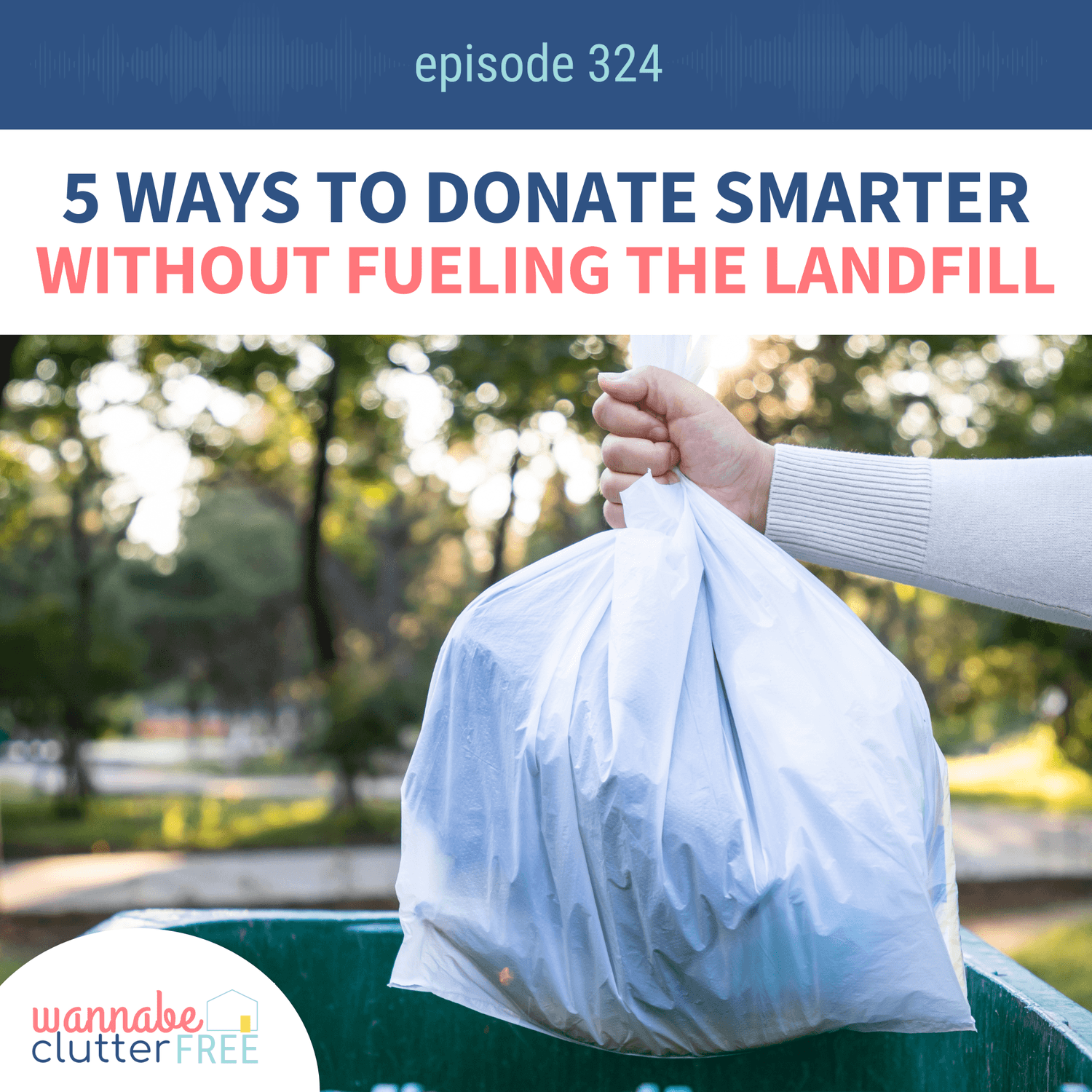
Do you have a donation bag, bin, or box sitting in your house right now waiting to leave?
You’re not alone.
In fact, the hardest part of decluttering often isn’t deciding what to keep - it’s figuring out what to do with the stuff once you’ve let it go.That’s why this guide exists.
You’ll learn how to close the loop on decluttering with less guilt, less overwhelm, and more clarity about where your items actually go. You’ll also get practical options for donating, selling, recycling, and throwing away items responsibly, so your home can finally stop feeling like a storage unit.
Why Decluttering Has Two Decisions, Not One
Most people are great at the first decision:
Do I keep this or let it go?
That’s the part we usually call decluttering. But there’s a second decision hiding in plain sight:
Where does this item go next?
That second decision is where momentum often dies.You declutter the closet, fill a bag, and set it by the door. Then the bag moves to the car. Then it sits in the trunk for weeks. Meanwhile, you’re still carrying the mental load of “I need to deal with that.” The item is no longer in active use, but it’s still taking up energy in your life.
The goal isn’t to become perfect. The goal is to finish the loop.
You already did the hard part by letting go. Now you just need a realistic system for the exit.Here’s the simplest shift: stop thinking of decluttering as a one-step process. It has two parts.
Decide whether the item stays.
Decide where it leaves.
If you can make that second part easier, you’ll declutter more consistently and with far less stress.
What Happens to Donated Stuff After It Leaves Your House?
A lot of people assume donated items go straight to someone who needs them. Sometimes they do. But often, that’s not the full story.Estimates suggest that only about 10% to 30% of donated items actually make it to the sales floor.
That means 70% to 90% may never be sold at all. Some items are sorted out, some are too worn or broken, and some are shipped elsewhere in bulk. If you’ve ever wondered why thrift stores are so selective, this is part of the reason.
Clothing is especially complicated. A huge volume of used garments enters the global secondhand trade, and not all of it is usable when it arrives. Ghana receives around 15 million used garments per week, and a significant portion is unsellable. That’s a sobering reminder that “I’ll just donate it” is not always a complete solution.
This doesn’t mean you should stop donating. It means you should donate more thoughtfully.Ask yourself:
Is this actually usable?
Would I give this to a friend or neighbor?
Is this something a thrift store is likely to sell?
Would a recycling stream handle this better?
The more honest you are about an item’s condition, the better you can choose its next stop.
How to Choose the Right Exit Route for Your Items
When you’re decluttering, your goal is not to make every item someone else’s problem. Your goal is to move each item to the place that makes the most sense for its condition and usefulness.
Here are the five main exit routes to think about.
1. Give It Away to Someone Who Will Use It
If the item is still useful and in good condition, giving it away directly is often the easiest and best option. Deanna recommends buy nothing groups first, and for good reason. They’re local, fast, and low-effort. You post a photo, describe the item, and someone who genuinely wants it comes to pick it up. No shipping. No haggling. No garage-sale weekend.
Other easy options include:
Facebook Marketplace
Nextdoor
Neighborhood free piles or front-yard giveaways
Porch pickup arrangements
This works especially well for:
Furniture
Rugs
Toys
Clothing
Home goods
Duplicate household items
The big advantage here is that the item goes to someone who already wants it. That means less waste, less sorting, and less guilt.
2. Sell It - But Only If It’s Worth Your Time
Selling can make sense, but only if you have the bandwidth.This is where a lot of decluttering plans fall apart. You tell yourself you’ll sell everything, and suddenly you’ve created a second job. Photos, descriptions, messages, meetups, shipping, follow-ups - it adds up fast. If you’re already overwhelmed, this route can drain your energy.
A better approach is to set a threshold. For example:
Sell only items worth more than $20
Sell only name-brand or high-value items
Sell only what can be listed quickly
Start with the highest-value items first. That way, if you run out of steam, you’ve already handled the pieces that matter most financially.
Platforms I use include:
Vinted for clothing
Facebook Marketplace for larger items
Poshmark, eBay, and Depop for certain resale categories
If it doesn’t sell within a week or two, let it move on. Don’t let “maybe I could still get $8 for this” keep it stuck in your house.
3. Donate Locally and Specifically
If you have a little more time, local and specific donation can feel much better than dropping everything at a generic donation center.
Think about who actually needs the item. For example:
Domestic violence shelters
Refugee resettlement agencies
Habitat ReStores
Animal shelters
Teachers
Senior centers
Creative reuse centers
Community organizations helping people transition into housing
This is one of the most satisfying ways to donate because you can match the item with a real need. A blanket, a puzzle, a set of kitchenware, or an office chair can make a direct difference in someone’s life.
It feels incredible to donate to an organization where you can actually see the item used later. That kind of feedback loop makes decluttering feel meaningful instead of random. Before you drop something off, call or check the organization’s website to see what they accept. A few minutes of research can save a lot of unnecessary sorting later.
4. Recycle Specialty Items That No One Wants
Some things should not be donated at all. They’re too worn, broken, stained, or unsafe. That doesn’t mean they belong in the trash by default. It means they may need a specialty recycling stream.
Some useful options include:
Target Textile Drop Spots - in California Targets, and they accept clean, dry clothing, sheets, and towels in any condition
H&M textile recycling
Trashie - mail-in textile recycling
Soles4Souls - for wearable shoes
Got Sneakers - for used athletic shoes
Nike - for worn athletic shoes
Best Buy - for electronics
Staples - for electronics and some batteries
Call2Recycle - for batteries
This matters because many “unwanted” items can still be processed into something useful if they’re sent to the right place. That includes textiles, shoes, batteries, cords, and small electronics.
One important note: batteries are not something you should toss in the trash. Lithium-ion batteries can start fires in garbage trucks, so proper disposal matters for safety, not just sustainability.
5. Throw It Away When It’s Actually Trash
This is the part many people avoid saying out loud: some items are trash. Broken toys. Used-up coloring books. Dolls with missing heads. Shirts with holes and stains. Cracked plastic. Worn-out items that nobody would want to receive.Those things do not need to be passed along just because they technically once had a purpose. When donations include literal garbage, volunteers and workers have to do the emotional and physical labor of sorting it. That’s not generosity - that’s outsourcing your decision.
A simple test can help:
Would you give this to a friend, neighbor, or someone you have to see again?
If the answer is no, it probably shouldn’t be donated. Recycle it if possible. If not, let it go in the trash without guilt. Throwing away a ripped shirt is not a moral failure.
How to Declutter More Sustainably Going Forward
The most sustainable donation strategy starts before the item ever enters your house.That’s the part people often forget. You can spend hours sorting, donating, recycling, and researching, but the biggest impact usually comes from bringing less stuff in to begin with.
Think in terms of less in, less out.
When you buy with more intention, you reduce the future burden of decluttering. That means fewer donation bags, fewer landfill decisions, and less stress down the line. It also helps you avoid impulse purchases that later become guilt piles in your trunk.
A few practical habits to try:
Wait 24 hours before buying non-essentials
Ask whether you already own something that fills the same role
Buy only what you know you’ll use
Choose quality over quantity
Keep a smaller “maybe” list for things you’re tempted to buy
You can also make your decluttering process easier by working in short bursts. I recommend 10- to 20-minute sessions instead of trying to do the whole house in one weekend. That same logic applies to donations. Sort a small pile, pick one exit route, and move it out.
If you’re making progress a little at a time, you’re still making progress.
Resources Mentioned
Your local Buy Nothing group or Nextdoor for fast, no drive giveaways
Connect
Follow along in real time on Instagram at @WannabeClutterFree. I am documenting every single day of this.
New episodes every Wednesday. Find all the show notes at wannabeclutterfree.com.
Timestamps:
00:00 The bag that has been in your car for six weeks
03:30 Where I am right now: moving, decluttering 500 things
06:00 The two decisions inside every declutter
09:00 How much of your donation actually gets sold
12:00 Ghana, Kantamanto, and 15 million garments a week
15:30 How to spot a donation bin that is not a charity
19:00 The truth about big box thrift chains
23:00 Your guilt is not keeping anything out of a landfill
26:30 The headless doll: what I found volunteering this summer
31:00 Place 1: Give it away first
35:00 Place 2: Sell it, but only if you have the bandwidth
39:00 Place 3: Donate local and specific
43:00 Place 4: Specialty recycling (Target, H&M, Trashie, shoes, makeup, electronics)
49:00 Place 5: Throw it away and let it go
52:00 Shifting from decluttering to inflow
Don't forget to subscribe to the Wannabe Clutter Free podcast (on your favorite podcast player!) so you never miss an episode. And if you liked what you heard today, please leave a rating and review for the show too! It helps others find the show and makes my day.
BEFORE YOU GO!
✨ Snag my DAILY routine that keeps my home tidy & calm in just minutes a day ✨

cheers!
About Deanna Yates
Based in San Diego, CA, Deanna helps high-achieving moms clear the clutter from their homes and lives.
Through coaching, courses, summits, and her top-ranked Wannabe Clutter Free podcast, she supports modern women in building organized, peaceful homes where they can thrive.


Some of the links on this site are affiliate links for your convenience (which means if you make a purchase after clicking a link I will earn a small commission but it won’t cost you a penny more)! Read my full disclosure policy.
Wannabe Clutter Free is a participant in the Amazon Services LLC Associates Program, an affiliate advertising program designed to provide a means for sites to earn advertising fees by advertising and linking to Amazon.com.
© 2026. All Rights Reserved